Stage One Confusion
Parsa is taking a multiple-choice exam with questions. He looks at the questions in order, answers some of them, and never goes back.
Parsa's answer sheet contains answers. The -th answer says that he chose option for question . The question numbers on the sheet are strictly increasing.
Parsa may have made at most one copying mistake on the sheet. Such a mistake could have happened to one consecutive block of his answers: while copying that block onto the sheet, every intended question number in the block was changed by the same nonzero offset. More precisely, starting from Parsa's intended answer sheet, one copying mistake consists of choosing one block ~l, l+1, \ldots, rdq_i~ to .
Both the intended question numbers and the written question numbers must be strictly increasing and between and . You may also decide that no mistake was made.
Given the correct answer key and Parsa's answer sheet as written, find the largest possible number of answers Parsa could have gotten correct before the copying mistake was made.
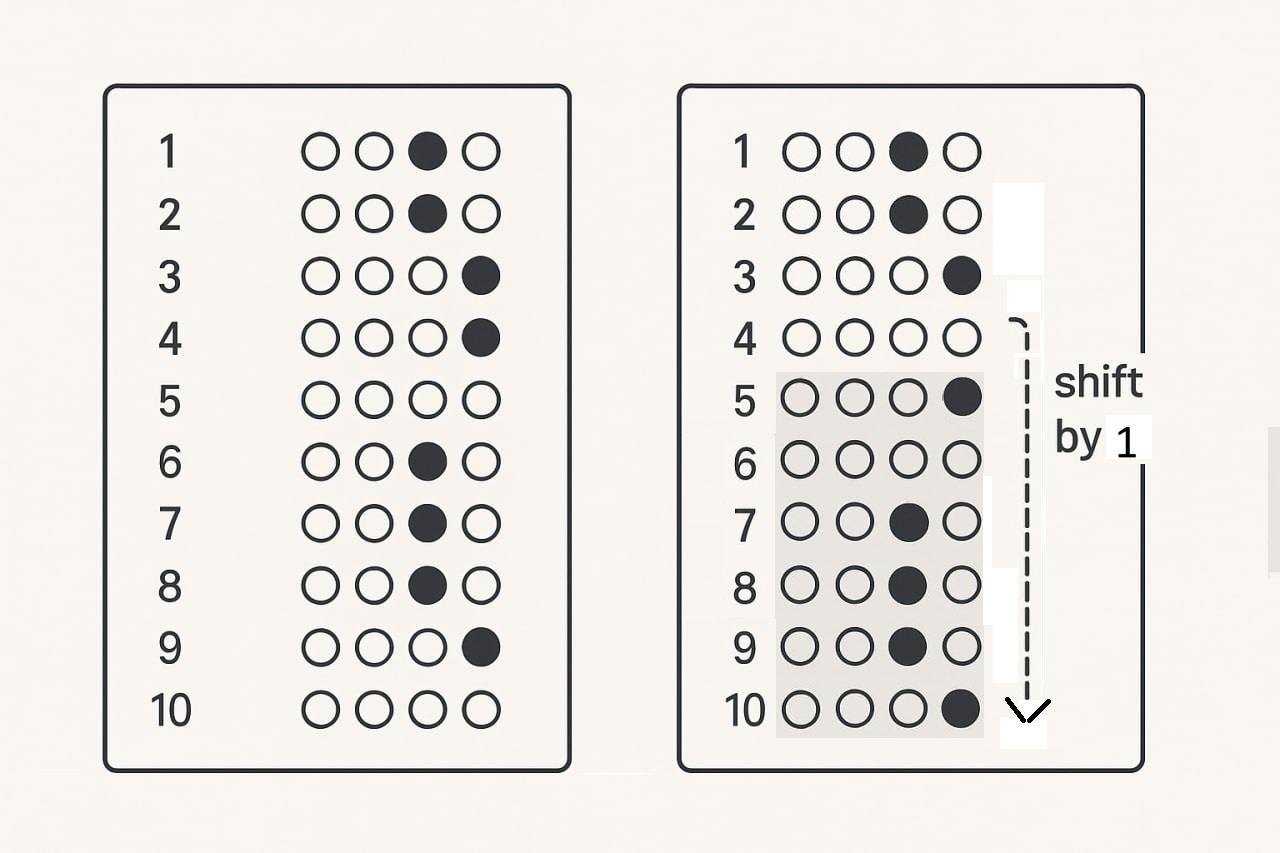
In the picture, one block is shifted by while being copied onto the sheet.
Input
The first line contains an integer , the number of test cases.
Each test case has the following format:
- The first line contains two integers and .
- The second line contains a string of length . The -th character is the correct answer for question .
- The next lines each contain an integer and a character , meaning Parsa wrote answer for question .
If , it is guaranteed that .
Output
For each test case, print one integer: the maximum possible number of correct answers on Parsa's intended answer sheet, before any copying mistake.
Constraints
- The sum of over all test cases is .
- Each character of and each is one of
A,B,C,D, orE.
Example 1
5
5 4
AECDB
1 A
2 A
4 C
5 B
7 2
AAACDAA
1 C
3 D
7 2
AAACDAA
1 C
2 D
10 5
ABECCDBAEA
3 B
4 E
6 C
8 A
10 E
4 0
ABCD
3
1
2
4
0
Explanation
In the first test case, the score on the sheet as written is . Parsa could have originally written that answer for question , then copied it as question by mistake. Before that mistake, his score would have been .
Comments0
No comments yet
Be the first to comment.
New comment
Log in to join the discussion.